
Both flagship detergents were renamed in the last eighteen months, the internet’s favorite fact about pod film comes from a study funded by a company selling the alternative, and the current top performer in Consumer Reports‘ testing is a warehouse-club store brand. If you’re shopping from a list written before 2025, almost every name on it has changed.
Here’s the 2026 landscape, including the part everyone gets wrong about why dishes stopped coming out clean.
Our Top Dishwasher Detergents
Why Your Dishes Stopped Getting Clean
The complaint is real and it has a date: July 2010, when seventeen states implemented bans on phosphates in automatic dishwasher detergent. Rather than run separate formulas, manufacturers reformulated nationally.
Phosphates did two jobs no replacement does as well: they softened water by binding calcium and magnesium, and they kept loosened food suspended so it drained away instead of redepositing. Reformulated detergents leaned on enzymes, citrates and polymers. Contemporary testing — the New York Times, Consumer Reports and Chemical & Engineering News all covered it in 2010–11 — found the phosphate-free versions cleaned measurably worse at first.
Formulas have improved a great deal since. But two structural things changed alongside them, and they’re why cleaning still feels marginal:
- Machines use far less water. The federal limit is 5.0 gallons per cycle today and drops to 3.3 gallons in April 2027. Less water means less dilution and less mechanical rinsing.
- Cycles got long and cool. Bosch’s own manual shows its Normal cycle running 2 hours 10 minutes at 127–136 °F — the lowest-energy, lowest-water setting. Time substitutes for heat and volume.
Detergent has to do more work with less help. That’s the real story.
Stop Pre-Rinsing — Here’s the Manufacturer’s Own Reason
Every detergent brand tells you not to pre-rinse and it sounds like marketing. It isn’t, and the best explanation comes from an appliance manual rather than a detergent ad. Bosch’s troubleshooting guide lists this under “food remnants on dishware”:
“Dishware has been precleaned too intensively. Then the sensors choose a lighter cycle. Stubborn remnants cannot be entirely removed. → Only remove large remnants of food and do not pre-rinse dishware.”
Modern dishwashers have soil sensors. Rinse everything first and the sensor reads clean water, concludes the load is light, and runs a shorter, gentler cycle. You get a weaker wash because you helped. Scrape off the large pieces and load it dirty.
While we’re in that manual: the second cause listed for poor cleaning is a dirty filter, and Bosch instructs owners to “check the filters for residue after each wash.” After each wash — not monthly. It’s the most-skipped fifteen seconds in any kitchen.
The Best Dishwasher Detergents in 2026
1. Cascade Platinum Plus ActionPacs — Best Overall
About 38 cents a load in the 57-count. A three-chamber pod with a liquid top compartment, enzymes for stuck-on food, and Dawn grease-cutting surfactants — Procter & Gamble’s most-upgraded formula in a decade, refreshed again in 2025. Phosphate-free, and it prevents the hard-water filming that plain enzyme detergents leave behind.
Cascade and Finish have traded the crown for fifteen years and it’s genuinely close. What tips it here is consistency across water conditions and the fact that Consumer Reports‘ current top tier includes it.
Specifications:
- Format: 3-chamber ActionPac with liquid
- Cost: ~$0.38/load (57 ct)
- Phosphate-free; enzymes; oxi variant available
PROS:
- Strong across hard and soft water
- No pre-wash needed
- Widely available at warehouse-club pricing
CONS:
- Plastic film pod (see the PVA section below)
- More expensive than the Finish flagship
Conclusion
The safe default. If you’ve never systematically compared, buy this and stop thinking about it.
2. Finish Ultimate Quantum — Best Value Flagship
Launched in March 2026 and, at roughly 32 cents a load in the 70-count, both newer and cheaper than Cascade’s flagship. Wrapper-free tabs — no plastic film to peel or worry about — with enzymes and bleach, claims of handling 24-hour dried-on residue without pre-rinsing, and formulation for hard water and older machines.
If your old list says “Finish Quantum Max,” “Ultimate Plus” or “Powerball Deep Clean,” those names are gone from Finish’s own lineup. This replaced all of them.
One thing we could not confirm: Finish does not state phosphate-free status on this product’s page, so we’re not claiming it.
Specifications:
- Format: wrapper-free tab
- Cost: ~$0.32/load (70 ct)
- Enzymes plus bleach; septic safe
PROS:
- Cheapest per load among premium detergents
- No pod film at all
- Newest formula on the shelf
CONS:
- Too new for independent lab testing
Conclusion
The value pick among flagships, and the one to try if pod film bothers you but you don’t want to pay eco-brand prices.
3. Finish Quantum Hard Water + Lemi Shine — Best for Hard Water
If your glasses come out cloudy no matter what you buy, the problem isn’t your detergent — it’s dissolved calcium and magnesium. The USGS classifies water above 121 mg/L as hard and above 180 as very hard, and hard water is common across the east-central and western United States.
Two things help. Finish makes a dedicated hard-water Quantum — a SKU that didn’t exist when we first wrote this guide, which tells you how widespread the complaint is. And Lemi Shine (about $21 for the large bottle) is a citric-acid booster you add alongside your normal detergent; the acid binds the minerals so the detergent can do its actual job.
There’s a third answer most Americans don’t know exists: a built-in water softener in the dishwasher itself. It’s standard in Europe and rare here — among Bosch’s US lineup, only the Benchmark series has one, with Bosch selling the salt under its own part number. If you’re replacing the machine anyway and your water is hard, that feature will outperform any detergent you can buy.
Conclusion
Hard water is a water problem, not a detergent problem. Treat it as one.
4. Blueland Tablets — Best Plastic-Free
A compressed dry tablet with no film of any kind, about 35 cents a load, shipped in compostable paper. It carries EPA Safer Choice certification and Cradle to Cradle certification — real third-party programs, not self-declared eco language — and it’s free of phosphates, chlorine bleach, phthalates and parabens, with rinse aid built in.
This is the honest answer for anyone who wants out of the pod-film debate entirely rather than adjudicating it. Dropps makes a comparable tablet at about 46 cents a load with USDA certified biobased content.
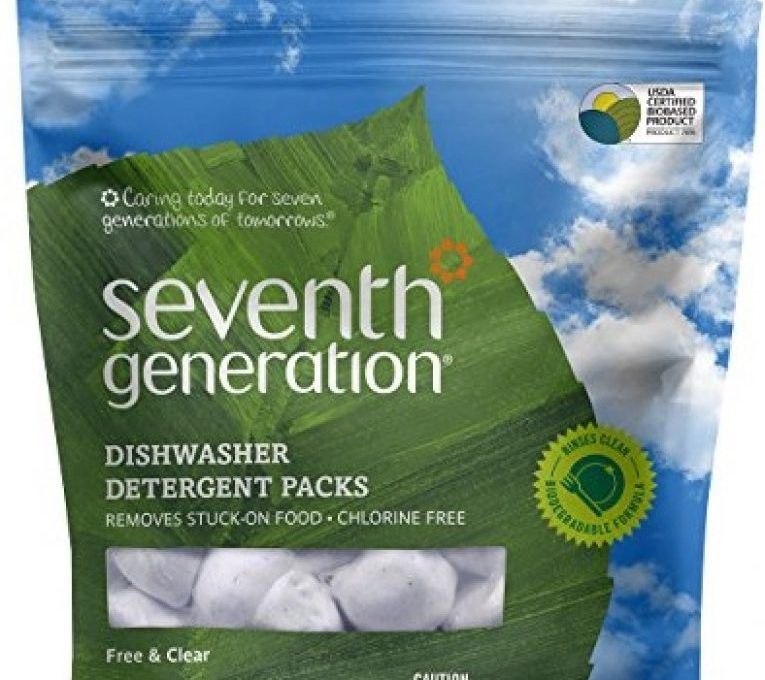
Worth noting for the eco-minded: Seventh Generation’s packs contain polyvinyl alcohol — the same film chemistry as conventional pods. Being a green brand doesn’t mean being film-free; only the tablets are.
Specifications:
- Format: compressed tablet, no film
- Cost: ~$0.35/load; starter set $25
- EPA Safer Choice; Cradle to Cradle certified
PROS:
- Genuinely no plastic film
- Real third-party certifications
- Built-in rinse aid
CONS:
- Roughly triple the cost of store-brand pods
- Direct-order subscription model
Conclusion
The clean-conscience option with credentials behind it, at a real price premium.
5. Cascade Complete ActionPacs — Best Budget Name Brand
About 25 cents a load in the 100-count — a third less than Platinum Plus for a formula that still has Dawn grease-cutting power, food-seeking enzymes and hard-water film protection. For everyday loads that aren’t baked-on casserole dishes, the step down from Platinum is barely noticeable.
Going cheaper still: Walmart’s Great Value pods run about 12 cents a load, and Consumer Reports notes that store-brand detergents perform impressively for the money. That’s not faint praise — CR’s current top-rated detergent is Sam’s Club’s Member’s Mark Platinum Clean, ahead of both Cascade and Finish.
Specifications:
- Cost: ~$0.25/load (100 ct)
- Phosphate-free; enzymes; Dawn surfactants
PROS:
- Two-thirds the cost of the flagship
- Same brand chemistry family
CONS:
- Less effective on 24-hour baked-on food
Conclusion
The sensible everyday buy. And if you have a warehouse membership, try the house brand before assuming the national labels win.
Are Pod Films an Environmental Problem? Honestly, It’s Contested
You’ve probably seen the claim that detergent pods dissolve into plastic pollution. Here’s the actual state of the evidence, both halves.
The study: a 2021 paper in the International Journal of Environmental Research and Public Health estimated that about 17,200 metric tons of polyvinyl alcohol enter US wastewater annually from laundry and dish pods, and modeled that roughly 77% survives conventional treatment. The disclosure that belongs alongside it: the research was funded in part by Blueland, which sells film-free tablets. The authors state the funder had no role in the design or analysis — both facts are true and both belong in the sentence.
The counterweight: polyvinyl alcohol appears on the EPA’s Safer Chemical Ingredients List, and as of the agency’s September 2025 file it’s still there. The American Cleaning Institute says detergent-grade PVA dissolves and biodegrades within 90 days, citing several studies — though it doesn’t directly address the 2021 paper.
Where that leaves you: one modeling study funded partly by an interested party, an industry rebuttal from a trade association, and a federal agency that still lists the chemical as safer. Nobody has resolved this. If it bothers you, tablets exist and work fine. If it doesn’t, the regulator hasn’t told you it should.
Detergent FAQ
Do I still need rinse aid?
It depends on your dishwasher’s drying system, not your detergent. Condensation drying — Bosch’s 100 and 300 Series and most budget machines — genuinely depends on rinse aid to sheet water off dishes. Zeolite systems like Bosch’s CrystalDry and Miele’s door-opening AutoOpen are far less sensitive. Consumer Reports says a separate rinse aid gives maximum effect even with detergents that include it; Blueland and Dropps say theirs is built in and sufficient. Try without and add it if you see spots.
Pods, gel or powder?
Pods dose correctly every time and cost the most. Gels are cheapest per load and let you use less for light loads. Powder still exists but CR stopped testing it in 2019 as availability declined. For most people, pods.
Why didn’t my pod dissolve?
Wet hands or a wet dispenser compartment start dissolving the film early and glue it shut. Keep both dry, and make sure the compartment door can open fully — a tall pot leaning against it will block it.
Does more detergent clean better?
No, and in soft water it makes things worse: excess detergent needs mineral content to bind to, and without it you get etching on glassware over time. Use one pod.
Is expensive detergent worth it?
Sometimes. The gap between a 12-cent store-brand pod and a 38-cent flagship shows up on baked-on and 24-hour-old food, not on rinsed-that-evening dishes. Given that CR’s current leader is a store brand, it’s worth testing the cheap option on your actual dishes before committing.
Summary
Buy Cascade Platinum Plus if you want the safe answer, or Finish Ultimate Quantum for a newer formula at 32 cents a load with no film. Cloudy glasses mean hard water — add Lemi Shine or buy the hard-water Finish. Skipping plastic entirely, Blueland tablets have the certifications to back the claim. And on a budget, Cascade Complete at 25 cents or a store brand at 12 will handle ordinary loads.
Then do the two free things: stop pre-rinsing, and clean the filter. Between them they’ll do more for your dishes than switching brands. Our updated dishwasher guide covers the machine side, including why the normal cycle now takes two hours.


